
Orbiting Ambitions: The Dawn of Space-Based AI Data Centers

In the shadow of Earth's overburdened power grids, a new frontier beckons for artificial intelligence: the cold vacuum of space. What began as a quirky pitch from unassuming startup Starcloud - flinging NVIDIA GPUs skyward to test orbital compute - has snowballed into a cosmic gold rush.

Even OpenAI's Sam Altman flirted with the stars, eyeing a stake in reusable rocket pioneer Stoke Space. As launch costs plummet and solar yields soar, these ventures promise not just innovation, but a paradigm shift: AI infrastructure where sunlight is infinite, cooling is cosmic, and scalability knows no gravity.
Starcloud's Bold Leap: GPUs in the Void
The spark ignited in early 2025 when Starcloud, a Y Combinator and NVIDIA Inception alum formerly known as Lumen Orbit, launched Starcloud-1 - a 60-kilogram satellite packing an NVIDIA H100 GPU, the most powerful chip ever lofted into orbit by over 100x.

By December 10, Starcloud achieved a milestone: training and querying Google's open Gemma LLM from low Earth orbit (LEO) at 325 km altitude, marking the first orbital run of a high-powered AI model.
Starcloud's vision scales wildly: a 5-gigawatt orbital behemoth, sprawling 4 km across with vast solar arrays and radiative cooling fins that exploit space's vacuum as an "infinite heat sink." No evaporation towers guzzling freshwater; instead, infrared waste heat dissipates directly into the void, slashing Earth's water footprint by billions of gallons annually.
Constant solar exposure - unmarred by clouds or night - delivers near-limitless power, with CEO Philip Johnston touting 10x lower energy costs than ground-based peers. Initially targeting satellite-to-satellite GPU services, Starcloud eyes hyperscale AI clusters by 2035, partnering with Crusoe for limited access in 2027.
NVIDIA's backing, including H100s and forthcoming Blackwell chips, underscores the bet: Orbital compute could eclipse terrestrial limits, where U.S. data centers alone consumed 4% of national electricity in 2024.
Bezos' Blueprint: Gigawatts in the Heavens

Speaking in Turin on October 3, the Amazon founder and Blue Origin helmsman framed orbital infrastructure as inevitable, leveraging 24/7 solar bounty - eight times Earth's yield - to outpace ground costs "in the next couple of decades."
Blue Origin, his aerospace venture, has quietly toiled for over a year on enabling tech, from reusable New Glenn rockets (with partial reusability debuting in 2025) to radiation-hardened servers.
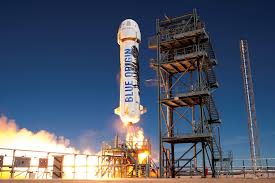
Echoing Eric Schmidt's 2025 Relativity Space buyout for similar aims, Bezos sees space as "the next step" for Earth-bound progress - decoupling AI from fossil fuels while preserving planetary resources.
Google's Suncatcher: Swarm Intelligence in Orbit
Enter Alphabet's moonshot: Project Suncatcher, unveiled November 2025 as a bid to "unlock AI's fullest potential" via space-scaled machine learning. Born from a ragtag team of engineers' back-of-the-envelope sketches, it greenlit prototype satellites for a 2027 launch via Planet Labs partnership - two solar-powered nodes bristling with Google TPUs for AI acceleration.

Laser links, akin to Starlink's inter-satellite beams, enable low-latency chatter at 100 Gbps+, minimizing Earth downlink delays. Energy math dazzles: Orbital panels harvest 8x terrestrial output, ditching batteries for continuous ops and slashing mass by 70%.
Radiation resilience? Suncatcher's Trillium TPUs (v6e lineage) endured particle accelerator barrages equivalent to five-year missions, logging bit-flips but zero permanent failures - memory subsystems faltered only at 3x expected doses. No fab tweaks needed; off-the-shelf silicon suffices, per arXiv preprint 2511.19468. Cost convergence seals it: With launches dipping below $200/kg mid-2030s (down from $2,700/kg in 2020), orbital ops rival ground power bills - $0.02-0.05/kWh versus space's "free" solar.
Altman's Stellar Gambit: Eyes on Stoke Space

Altman sought control via equity, aiming to bolt orbital launch muscle onto OpenAI's AI empire - countering Musk's SpaceX dominance amid their frosty co-founder history.
Though the deal fizzled, it signals Altman's horizon: Space as AI's ultimate moat, with prior bets like Longshot Space for combustion-free launches.
Cosmic Horizons: Dreams in the Data Deluge

Hurdles loom - radiation quirks, laser-bandwidth bottlenecks, $100B+ upfronts - but falling launches (SpaceX's Starship at $10/kg target) and solar surfeits tip the scales. As Bezos quips, "The future is going to be a lot more fun if we do it in space." In these times, we don't just dream big - we launch it.
Also read:
- Pebble's Founder Reinvents Wearables with a $75 "Brain Memory" Ring: Simple, Open-Source, and Subscription-Free
- Failwatching: Gen Z's Darkly Relatable Office Escape in a High-Stakes World
- Substack's Native Sponsorships: Revolutionizing Creator-Brand Partnerships in the Newsletter Era
- How to Launch a Profitable Startup – 5-Step Guide for Entrepreneurs
Author: Slava Vasipenok
Founder and CEO of QUASA (quasa.io) - Daily insights on Web3, AI, Crypto, and Freelance. Stay updated on finance, technology trends, and creator tools - with sources and real value.
Innovative entrepreneur with over 20 years of experience in IT, fintech, and blockchain. Specializes in decentralized solutions for freelancing, helping to overcome the barriers of traditional finance, especially in developing regions.
Subscribe to our newsletter
Get the latest Web3, AI, and crypto news delivered straight to your inbox.