Did Mars Previously Harbor Life? Will Life Be Sustainable There in the Future?
|For newbies| 2157
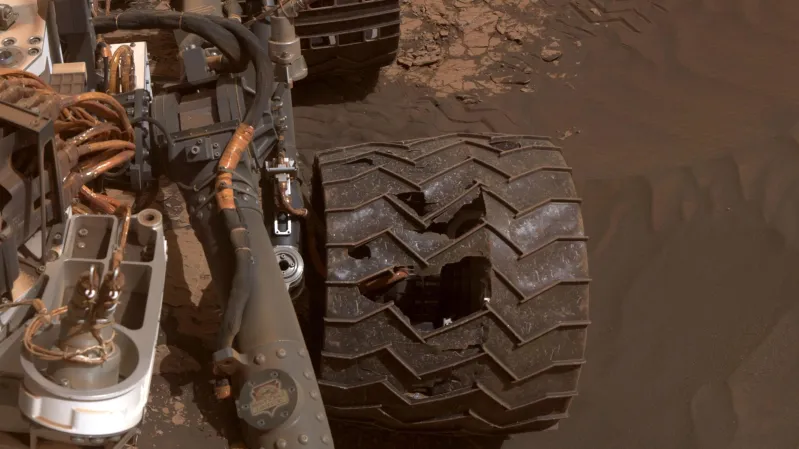
Curiosity’s aluminum wheels look severely damaged, but the rover remains mobile. A July 2026 mission update documents more than 23 miles (37 kilometres) of driving and over 4,400 feet (about 1.35 kilometres) of elevation gain, as well as continued work with the robotic arm, MAHLI, APXS, ChemCam and Mastcam.
That operational record puts the alarming wheel close-up published in September 2024 into context. The tears were real and remain a constraint on route planning, but they did not signal an imminent end to Curiosity’s mobility; nearly two years later, the rover was still climbing Mount Sharp and examining its layered rocks.
The widely circulated close-up depicts Curiosity’s right-middle wheel, one of six supporting the rover. A NASA wheel inspection from September 24, 2024 identifies the image as a MAHLI photograph acquired on September 22, during sol 4312, and assesses the wheel as still holding up well despite the punishment it had absorbed.
The photograph is striking because Curiosity does not ride on thick rubber tires. Its wheels are made from aluminum, so damage to the relatively thin metal skin between the raised structural treads remains exposed as openings and deformation. Those visible tears demonstrate substantial wear, but a close-up cannot establish by itself whether the wheel has lost its ability to bear loads or provide traction.
The inspection was also part of routine mission planning rather than an emergency diagnosis. Curiosity proceeded with contact science, remote observations and another planned drive, showing why the condition of a planetary wheel cannot be judged from appearance alone.
Wheel health depends on the remaining load-bearing structure and driving performance, not solely on the size of holes in the metal skin. Engineers can compare inspection images over time, observe how the rover responds during drives and consider the condition of the raised treads that supply traction. The complete mobility system also distributes the vehicle’s weight across six wheels rather than relying on the photographed wheel in isolation.
None of this makes the damage harmless. Every difficult crossing can place additional force on weakened material, and no physical repair is possible on Mars. The distinction is operational: a wheel can be badly worn while still performing its essential functions, but the remaining margin must be conserved.
Terrain therefore becomes a mechanical as well as a scientific decision. Angular rocks can threaten the wheel skin, loose material can increase slipping, and steep or uneven ground can change the forces acting on individual wheels. A destination may be reachable yet still rejected when its expected scientific value does not justify the additional wear.
Curiosity’s team cannot replace the wheels, so it manages their condition through driving software, inspections and route selection. Traction control adjusts wheel speeds when the rover crosses uneven ground, reducing harmful slipping and limiting the forces generated when one wheel climbs over a rock.
Route changes provide the clearest visible example of that strategy. In March 2022, Curiosity turned away from a dense field of wind-sharpened sandstone on Greenheugh Pediment; the JPL account of the “gator-back” detour explains that the rocks were not impassable, but crossing them would have aged the wheels without sufficient benefit.
This approach can make the rover’s path longer or exclude particular geological targets. It also preserves mobility for destinations judged more valuable, turning wheel wear into a resource-allocation problem: every hazardous drive consumes part of a finite mechanical reserve.
Curiosity was doing more than transmitting data from a fixed location. It continued moving between observation sites, positioning its robotic arm on selected rocks and measuring the chemistry, texture and structure of material in sulfate- and carbonate-bearing layers while approaching the Yardang unit on Mount Sharp.
The accumulated travel is useful evidence because it includes substantial movement after the damaged-wheel photograph drew attention. It does not predict an equal distance in the future, but it demonstrates that the wheel’s appearance was compatible with continued mobility and active science operations.
Elevation gain requires the same qualification. Past climbing shows that the mobility system continued to function under real Martian conditions; it does not guarantee that every future slope, rock field or patch of loose ground will be safe. Each route still has to be evaluated against the rover’s current condition.
No firm retirement date or precise remaining driving distance has been made public for Curiosity’s wheels. Wear depends on terrain, rock geometry, slopes, slipping and future route choices, so a photograph cannot support a credible kilometre-by-kilometre countdown.
The defensible conclusion is narrower. Curiosity’s wheels have sustained serious damage that affects where and how the rover moves, yet the mobility system remained functional in July 2026 after more than 23 miles of travel. The battered right-middle wheel is evidence of engineering margin being consumed—not evidence that the rover is already stranded.
Also read:


Get the latest Web3, AI, and crypto news delivered straight to your inbox.