Vertiv’s AI Boom Keeps Growing—and It Sells the Cooling AI Cannot Avoid
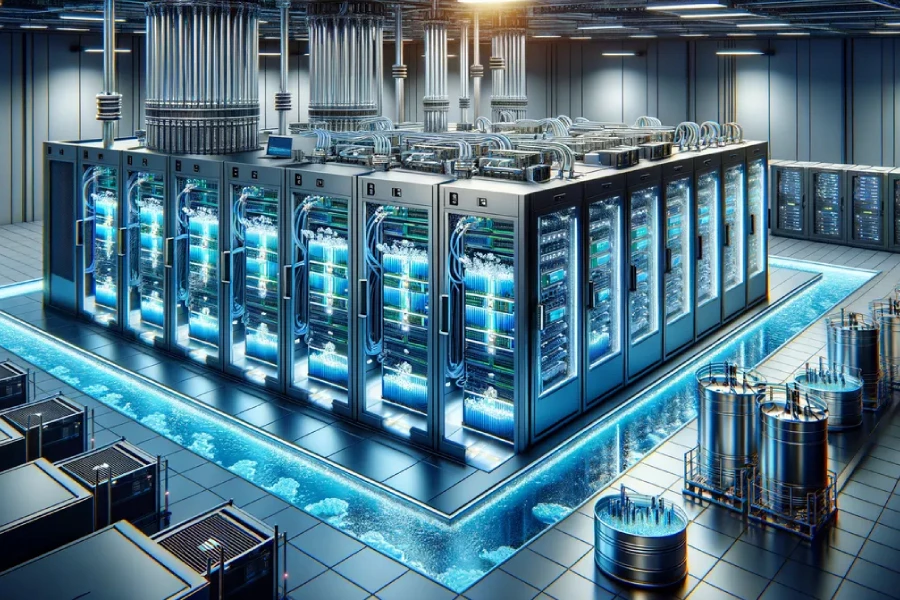
Vertiv’s AI-infrastructure business is still expanding in 2026, but the company is neither an AI developer nor a chipmaker. It supplies the power, cooling and supporting equipment that data centers need to operate increasingly dense computing systems. That physical dependency—not a current claim that Vertiv remains the market’s single best-performing AI stock—is the durable part of the story.
The latest financial update strengthens that conclusion. In Vertiv’s second-quarter 2026 results, the company reported $3.274 billion in net sales, 24% more than a year earlier, and raised the midpoint of its full-year sales forecast to $14 billion. Management attributed the demand environment to both AI and general-purpose computing while acknowledging temporary supply-chain congestion and more complicated, multi-stage deployments.
What Vertiv actually sells
Vertiv provides the infrastructure around computing equipment rather than the processors doing the computing. Its portfolio covers power distribution, uninterruptible power, thermal management, racks, monitoring, software and continuing services for data centers, communications networks and other critical facilities. In practical terms, it helps move electricity to servers, remove the heat those servers produce and keep important systems operating when normal power is interrupted.
Cooling is therefore only one part of the business, although it is the part most visibly connected with high-density AI hardware. Conventional room cooling can manage heat at the facility level, while denser racks increasingly require cooling closer to the equipment, including systems that move liquid through a controlled loop. The underlying commercial proposition is straightforward: more computing equipment, packed into less space and drawing more power, creates demand for a larger and more integrated layer of supporting infrastructure.
This explains why an industrial supplier can benefit from the same investment cycle as semiconductor companies. Buying accelerators does not create a functioning data center by itself. Operators must also secure an electrical connection, transform and distribute power, provide backup capacity, control temperature and humidity, monitor the installation and maintain it over its operating life.
The “highest AI stock gain” was a dated comparison
The superlative attached to Vertiv came from a specific market snapshot, not a permanent ranking. A December 2024 account of the comparison cited Jefferies data showing that Vertiv had gained more than 860% from the end of 2022, versus roughly 800% for Nvidia over a similar period. Those figures described returns measured at that time; they do not establish which company leads after subsequent price movements.
That distinction matters because a stock-performance league table changes with every chosen start date, end date and price adjustment. It can also obscure the difference between a company’s operating results and the price investors are willing to pay for those results. The defensible present-tense statement is narrower: Vertiv remained a rapidly growing supplier to the data-center expansion through the quarter ended June 2026.
The company’s latest numbers also show that the opportunity is broader than a single cooling product. Second-quarter product sales reached about $2.65 billion, while services contributed approximately $628 million. Vertiv raised its guidance after the quarter, but guidance remains a management forecast rather than completed revenue, and the company explicitly warns that projections depend on assumptions and changing risks.
Why the underlying business carries an environmental cost
The uncomfortable implication is not that cooling equipment is inherently sinister. It is that the AI economy depends on large physical installations whose electricity needs extend beyond the processors themselves. Every unit of electricity consumed by computing equipment ultimately becomes heat that must be moved away, and the pumps, fans, chillers and control systems performing that task require resources of their own.
The scale is continuing to grow. The International Energy Agency’s April 2026 update found that data-center electricity demand rose 17% in 2025, with AI-focused facilities growing faster, and projected total data-center consumption to double by 2030 while consumption at AI-focused centers triples. It also identified grid connections, transformers, advanced chips and other equipment as bottlenecks that can limit construction.
Cooling should not be treated as a fixed percentage of every facility’s power consumption. Its share varies with climate, server density, cooling architecture and the efficiency of the building. A modern hyperscale site and an older enterprise data center can therefore have very different overheads, even when both are described simply as data centers.
More efficient cooling can reduce that overhead, so growing sales for thermal-management equipment do not automatically translate into an equal increase in wasted energy or emissions. The larger environmental result depends on how much computing capacity is added, how efficiently it operates and which sources generate its electricity. Efficiency improvements may lower consumption per task while total demand still rises as more tasks are performed.
What Vertiv’s growth reveals about the AI buildout
Vertiv’s continuing expansion shows that AI investment has moved far beyond a race to manufacture the fastest processor. The buildout now pulls capital toward electrical equipment, thermal systems, construction capacity and long-term maintenance. These businesses can capture AI-related spending without producing a model, owning a cloud platform or designing a GPU.
For investors, that creates both an opportunity and a concentration risk. A supplier can benefit from multiple chip generations because every generation still needs power and heat management. At the same time, demand can be affected by data-center construction schedules, supply constraints, customer capital spending and the pace at which projects convert from plans into completed installations.
The current evidence therefore supports a more precise conclusion than the original stock-market superlative. Vertiv is still growing strongly alongside AI infrastructure spending, and the machinery it sells exposes the material underside of supposedly weightless software: electricity must be delivered, heat must be removed and facilities must be kept running. The grim element is not a mysterious corporate activity; it is the expanding resource burden built into the AI economy’s physical scale.
Also read:
Subscribe to our newsletter
Get the latest Web3, AI, and crypto news delivered straight to your inbox.